
Innovation Academy
Sustaining independent cultural space and breaking isolation through civic education, digital skills, creative expression, livelihoods and inclusive community infrastructure.
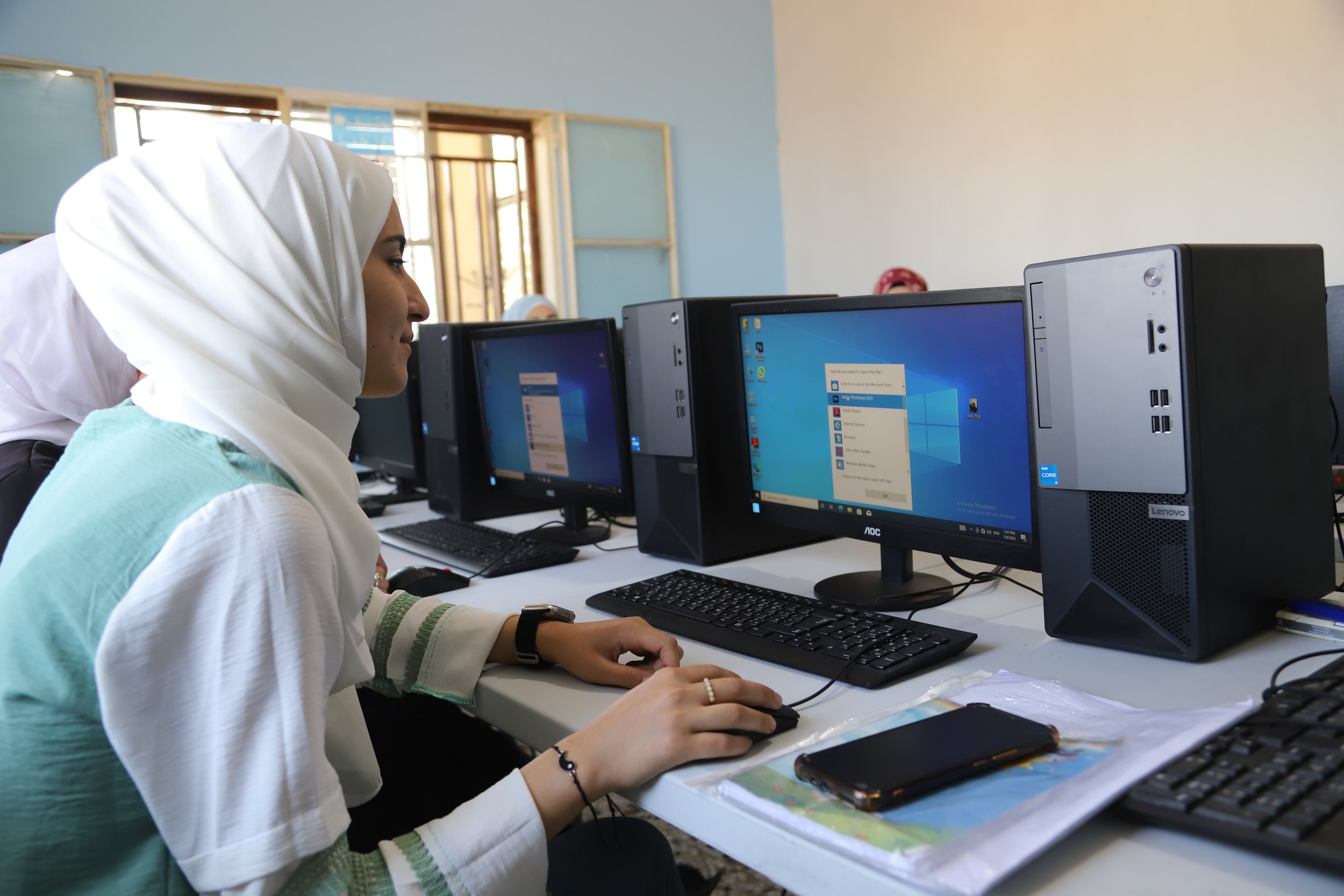
A community learning space designed to break isolation.
Sustaining Independent Cultural Space and Breaking Isolation, known as Innovation Academy, was Peace of Art's longest-running institutionally funded programme.
Supported by the Dutch Ministry of Foreign Affairs through PAX's Power of Voices strategic partnership, the programme began in February 2022 and was delivered through successive annual implementation cycles.
The initiative addressed limited access to structured civic education, digital literacy, creative learning and skills-development opportunities in North Bekaa.
Its approach combined practical training, civic participation, livelihood skills, arts-based activities and investment in accessible community infrastructure.
Implementation was shaped by Lebanon's economic crisis and, from September 2024, the disruption caused by armed conflict. Peace of Art adapted its activities while preserving the programme's underlying educational and civic objectives.
Building opportunity where access is limited.
Economic Constraints
Lebanon's economic crisis restricted household access to transport, connectivity and basic services, affecting young people's ability to access learning opportunities.
Limited Learning Infrastructure
North Bekaa faced a shortage of accessible, non-humanitarian civic education and structured skills-development programmes.
Conflict-Related Disruption
From September 2024, armed conflict interrupted training and increased community needs, requiring flexible implementation and emergency adaptation.
Four connected pathways to community resilience.
Digital & Creative Skills
Computer literacy, programming, English language, storytelling and creative expression.
Civic Education & Leadership
Advocacy, communication, conflict resolution, gender awareness, leadership and active citizenship.
Livelihoods & Entrepreneurship
Traditional carpet weaving, food preservation, soap making, entrepreneurship and design thinking.
Inclusive Infrastructure
A community sports court, solar power, improved physical accessibility and shared learning space.
Four annual cycles. One evolving community platform.
The programme developed over successive years, adapting training and infrastructure to community needs and changing conditions.
Establishing Skills and Infrastructure
The first cycle engaged 54 youth and 16 local teachers across digital learning, language education, livelihood skills and teacher training.
Eighteen participants joined the digital and language track, which delivered 36 sessions in computer literacy, English and storytelling.
Another 36 participants joined 15 livelihood sessions covering carpet weaving, food preservation and soap making.
Sixteen teachers received training in online teaching methods and gender-responsive classroom practice.
The cycle also included completion of a sports court and asphalt surfacing, alongside initial accessibility adaptations informed by consultations with young people with disabilities.
Strengthening Systems and the Youth Hub
The available documentation identifies progress in organisational management and community infrastructure.
Peace of Art completed financial-management training in coordination with MAAN and adopted QuickBooks as a formal accounting system.
The Ain sports and accessibility infrastructure, initiated in 2022, became fully operational as a youth hub.
A complete activity-level report for this cycle was not available in the documentation reviewed. Training participation and detailed annual results are therefore not quantified here.
Continuing Education Through Crisis
The programme reached 76 unique participants across sports-based wellbeing, computer literacy, English language and civic awareness.
The civic education and soft-skills track delivered all 45 planned sessions with 38 participants.
Following the escalation of armed conflict in September, the sports track completed 10 of 20 planned sessions, while the computer and English tracks each completed 18 of 22 planned sessions.
The women-only sports track responded to local social norms restricting women's access to physical activity. Participants self-reported improvements in mood and reduced social isolation.
During the crisis, Peace of Art temporarily redirected staff and volunteers to emergency humanitarian assistance before structured training resumed when possible.
Youth Leadership, Innovation and Adaptation
The final documented cycle combined computer programming, creative expression, self-defence, entrepreneurship, leadership and design thinking.
Fifteen participants attended 16 computer and programming sessions. Sixteen young people participated in 12 creative-expression sessions, including Lebanese, Syrian and Palestinian participants.
Fourteen young women attended 16 self-defence sessions, introduced after a planned volleyball programme could not proceed because its trainer relocated.
The cross-cutting entrepreneurship, leadership and design-thinking track reached 60 participants across the three cohorts through 80 sessions.
Five guest-speaker sessions and five field visits, involving 20 participants, connected learning with municipalities and regional heritage sites.
The cycle concluded with two youth-designed and youth-led community initiatives: a cross-community dialogue and capacity-building camp, and an exhibition supporting youth- and women-led micro-enterprises.
Skills, access and community participation.
Selected documented outputs and participant-reported experiences. Figures from different years are not combined into an unsupported total of unique beneficiaries.
People Reached in 2022
54 youth participants and 16 teachers across learning and professional training.
Unique Participants in 2024
Reached through four tracks, with overlap across computer and English training accounted for.
Civic Sessions Delivered in 2024
All 45 planned civic awareness, advocacy and soft-skills sessions were completed.
Reported Improved Mood
Self-reported by participants in the 2024 sports track; not an independently measured clinical outcome.
Reported Reduced Isolation
Self-reported by participants in the 2024 sports track.
Youth-Led Initiatives in 2025
A dialogue and capacity-building camp and a local micro-enterprise exhibition.
Designing learning spaces around real participation barriers.
Across the documented cycles, female participation exceeded male participation.
Programme reporting attributes this partly to work and financial obligations affecting young men's availability during Lebanon's economic crisis.
The programme responded to local participation barriers by providing women-only physical activity tracks in 2024 and 2025.
It also documented an intention to introduce more flexible scheduling to improve participation by young men, although this adjustment is not presented as a verified outcome.
Investments that remain beyond individual training cycles.
Community Sports Court
Construction and surfacing improvements supporting accessible recreational and sports activities.
Solar Power
Investment in power infrastructure to strengthen the reliability of the community learning space.
Accessibility Adaptations
Physical improvements informed by consultation with young people with disabilities.
Shared Youth Hub
A reusable community space supporting education, dialogue, sports and collaborative activities.
Responding to conflict without abandoning the mission.
Emergency Humanitarian Response
Following the September 2024 escalation, staff and volunteers temporarily supported displaced families and children through humanitarian response activities.
Psychosocial Support Integration
Psychosocial support was incorporated into subsequent training design in response to the conflict-affected operating environment.
Flexible Programme Design
The 2025 programme replaced a planned volleyball activity with self-defence training following the relocation of a local trainer.
Continuity of Community Learning
The programme resumed structured educational and civic activities when operating conditions allowed, adapting delivery to available resources.
Beyond individual projects. Building long-term local capacity.
Multi-Year Partnership
Continued institutional support through the Dutch Ministry of Foreign Affairs and PAX enabled successive annual programme cycles.
Permanent Infrastructure
Investment in sports, energy and accessible learning facilities created reusable community assets.
Participant Development
At least one documented participant subsequently returned as a paid trainer, illustrating a pathway from learning to local professional contribution.
Annual programme budgets.
The following figures are the reported annual cycle budgets from the supplied project documentation, not independently audited expenditure totals.
| Implementation Cycle | Reported Budget |
|---|---|
| 2022 | €50,163 |
| 2023 | 32,798 — currency to confirm |
| 2024 | €32,500 |
| 2025 (through September) | €35,815 |
This subtotal includes 2022, 2024 and 2025 only. The 2023 figure is excluded until its currency is confirmed. It is not a verified programme-wide expenditure total.
Detailed financial records are retained internally by Peace of Art. The programme document identifies the Dutch Ministry of Foreign Affairs, through PAX's Power of Voices partnership, as the funding framework.
International support. Locally rooted implementation.
Innovation Academy was implemented by Peace of Art in North Bekaa through a multi-year funding relationship involving PAX and the Dutch Ministry of Foreign Affairs.
The programme combined institutional partnership with local knowledge, participant feedback and practical adaptation to changing community needs.
This collaboration helped support an independent learning and cultural space serving young people, women, educators and community members.
A foundation for learning, participation and local resilience.
Innovation Academy brought together civic education, practical skills, creative expression, livelihoods and community infrastructure within one integrated programme.
Its multi-year design enabled Peace of Art to develop and adapt learning opportunities rather than rely exclusively on isolated short-term activities.
The programme also demonstrated the importance of flexible community-based implementation during economic and security crises.
Its reusable facilities, local training capacity and documented participant development provide a foundation for future community education and civic initiatives.
Sustainable community development begins when learning spaces become places of opportunity, participation and shared ownership.